
The Ethical Inquiry Approach
The Ethical Inquiry Approach is a structured method for engaging men who use violence while maintaining clear accountability and prioritising the safety of women and children. It focuses on how practitioners hold authority in difficult conversations, particularly when violence is denied, minimised, or disputed.
By carefully structuring inquiry and maintaining an ethical posture, practitioners can keep responsibility visible without resorting to confrontation or humiliation. The approach helps practitioners navigate these moments with clarity, allowing engagement, accountability, and safety planning to develop in ways that are both disciplined and respectful.


Ethical Inquiry: Engagement, accountability and assessing responsibility
Ethical Inquiry is a practice framework for engaging men who use family violence in statutory, community, and therapeutic settings. Developed through work in men’s behaviour change programs and child protection, it responds to a common challenge: how to hold men accountable while working within conditions of denial, dispute, and resistance to responsibility.
The framework begins from a simple observation. Accountability conversations often become organised around argument, persuasion, confession, or performance. In these interactions, responsibility can become difficult to assess and sustain.
Rather than attempting to persuade men to admit wrongdoing, Ethical Inquiry creates conditions in which responsibility can be encountered and evaluated. The focus shifts from extracting admissions to exploring values, obligations, relationships, and the effects of behaviour on others. Responsibility is not demanded or assumed. It is located, tested, and assessed through interaction.
For this reason, Ethical Inquiry functions as both an engagement framework and a diagnostic framework. The way a man responds to questions about fairness, respect, parenting, safety, and the impact of his behaviour provides valuable information about his relationship to responsibility. Practitioners and clinicians are able to assess not only what a man says, but how he manages accountability, disagreement, and ethical tension.
The information generated through this process assists practitioners and clinicians to assess readiness for change, identify barriers to accountability, and make more informed decisions about intervention, safety planning, restoration, and ongoing risk management.
Drawing on Narrative Therapy, Alan Jenkins’s Invitational Practice, family violence scholarship, and contemporary understandings of power, Ethical Inquiry provides a respectful and structured approach to accountability that helps practitioners maintain clarity, strengthen engagement, and generate meaningful information about responsibility and change.


The Helpful Ideas Wheel
Outsider Witness and Internalised Other
Controlling Boss Activity
The Controlling Boss whiteboarding activity has the dual effect of acknowledging oppressive power structures these men face in the workforce and utilising their own experience of the controlling tactics or supportive ways used by a boss or manager. Through this discussion, the men are invited to reflect on their behaviours towards family members, which promotes empathy, insight and motivates them to be supportive and respectful towards their partner in the same activity.
Below is a sample of what is written on the whiteboard following this exercise where the men get to reflect on their own words and make their own choices about what sort of partner they want to be; Controlling or Understanding.
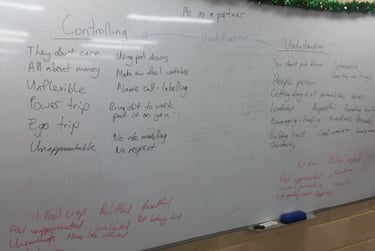
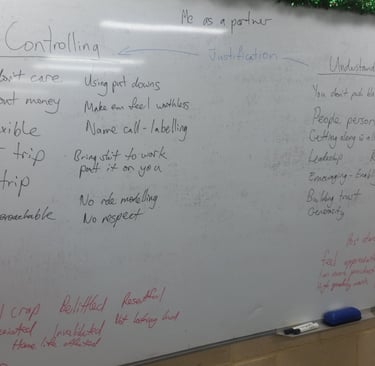
This is an essential activity in supporting the men's empathy towards their partner, to take greater responsibility for their actions and supporting them on their ethical journey.
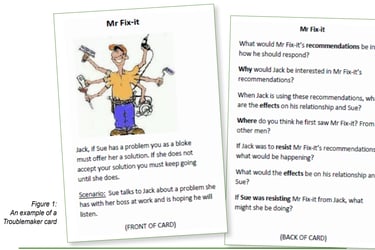
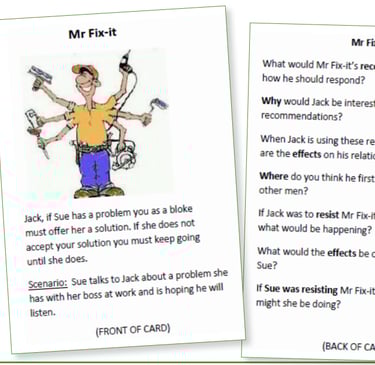
The Troublemaker Cards allow a man to develop the language and concepts that can expose and deconstruct the discourses he has subscribed to that support dominant male cultural interests. He can ask himself, ‘How did I become abusive?’ or 'What has restrained me from being respectful?' We can disturb the Troublemakers’ influence on men’s ways of being in different cultural contexts and better invite men to move towards preferences in relationships that are non-abusive and more respectful.
The Troublemaker Cards
© 2024 Parallel Journeys Consulting
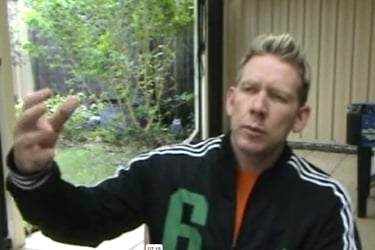
View Ryan's video on the Troublemaker Cards (17 min 12 sec)
A Friday Afternoon Production by Dulwich Centre Foundation
The Equality Cards
The Equality Cards support strengths-based questions used with a man who uses family violence to develop a respectful relationship and an ethical position on family violence. The circumstances to use strength-based questioning include;
The man is using denial or when he is declining to participate in the accountability process
The man is showing significant signs of defensiveness or protest in his behaviour
The man identifies with a marginalised group or has experienced significant trauma and injustice in his life
The worker decides it will be an effective way to start the accountability process
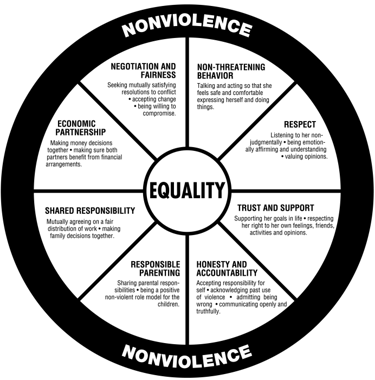
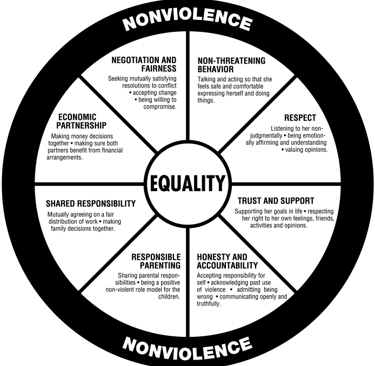
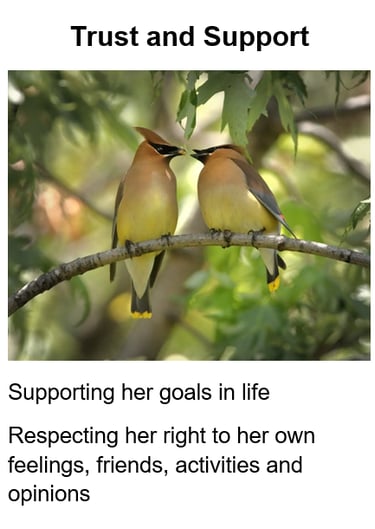
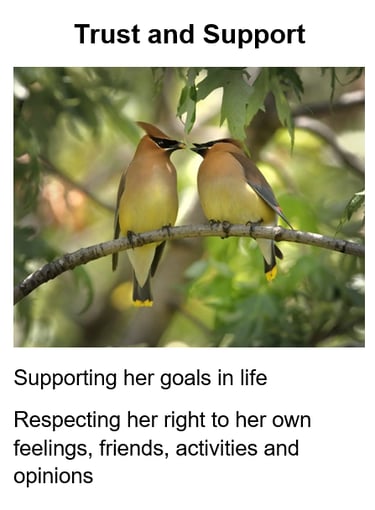
The Equality Cards are a way to have strengths-based conversations which are particularly useful when working with men who are marginalised, identify with a minority group or have experienced significant injustice or trauma in their life. The cards have been produced with the permision of 'Domestic Abuse Intervention Programs' as they are based on the Duluth Equality Wheel pictured below right. The cards scaffold concepts that assist the man in describing the actions and intentions he is striving for that support his family's safety. The cards are a physical way to engage the man and offer a point of focus during an accountable interview, group session or therapuetic session. Furthermore, men who have low levels of literacy can engage with them through pictures and scaffolding conversations offered by the worker.
Below is an example of one of the eight cards.
The cards come with a practice guide for use with;
men who use family violence towards female partners
women who experience family violence from a man
When using the cards to support women who have or are experiencing family violence, it assists in them in recognising the ways they prefer to be treated by a male partner.
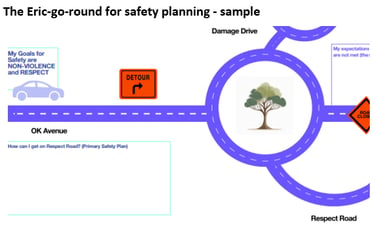
The Eric-go-round
For practitioners, the Eric-go-round offers a constructive and non-confrontational method to engage men who use abuse, fostering a respectful atmosphere that promotes family safety. When the practitioner is holding the men accountable to established safety principles in the weeks and months of men's behaviour change, using this method they continue to use the same concepts and language in the following weeks, guiding them along their ethical journey.
The Eric-go-round is a must-have safety planning tool that can achieve many things for the man, such as;
Have greater insight into his own behaviour in a safe and respectful space
Explore the effects of his abusive behaviour on his family
Explore the preferred effects of his non-abusive behaviour and actions on his partner and family
Develop better attitudes and thinking processes such as greater levels of respect, empathy and responsibility-taking
Develop actionable personal safety plans that can be honed and improved over time
Improvements in taking safe immediate actions during high-stress situations
Developing long-term safety for the family
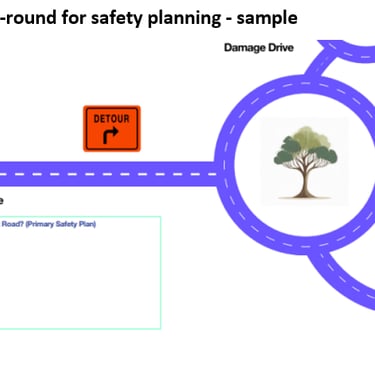
The Eric-go-round employs relatable metaphors such as cars, roads/intersections, and journeys, which symbolically represent the self, choices, and long-term safety planning and outcomes, respectively. This model encourages men to adopt new language while describing their abusive or non-abusive actions, transforming phrases like 'I snapped' or 'I had a short fuse' into more responsible expressions such as 'I went up Damage Drive.' For instance, one man described how he prevented himself from an abusive act when he said, 'I got on the roundabout.' These men report that during moments of high stress, the vivid imagery of the Eric-go-round becomes a cognitive tool to forestall violence when their capacity for reasoned thought is compromised.
We assert that men's abusive actions are entirely their responsibility, recognising that family violence is fundamentally an abuse of power. Nonetheless, should a man demonstrate insight and a willingness to change, we acknowledge that men can be supported in enhancing their cognitive and reasoning abilities during high-stress moments. Known as the 'fight or flight' response or 'downshifting' in brain function, this state engages the human body's sympathetic nervous system following a perceived threat, leading to increased heart rate, dilated pupils, and adrenaline release. Consequently, the brain's capacity to recall information, make decisions, and access detailed visual imagery from the frontal cortex is significantly impaired. Therefore, in a supportive and non-judgemental context, the Eric-go-round activity is designed to provide an intervention that aims to overcome these downshifting moments. With this in mind, we hold it in tension with the idea an abusive man may retain awareness and choice due to their dominant position in the family and that the perceived threat often stems from a sense of entitlement. This is why the Eric-go-round is best used in a program that coordinates other discussions to address male entitlement through the deconstruction of hegemonic masculinity, such as the Troublemaker Cards, the Gendered Hierarchy of Insults or the Troublemaker and Healing Wheels.
The Eric-go-round activity promotes more thoughtful decision-making during these high-stress moments and is a skill that develops over time with support from a practitioner. The activity's visual nature taps into the parts of the emotional midbrain responsible for direct visual processing and spatial awareness, which remain functional following a downshifting response. Therefore, the learned visual cues from the Eric-go-round can still be activated in these moments which supports a transition back to the body's parasympathetic nervous system—known as the 'rest-and-digest' response. This state helps conserve energy and restore calm by slowing the heart rate. In this resting state, an individual can engage the frontal cortex, applying cognitive and reasoning skills to consider the consequences of future actions and devise safer behavioural strategies.
While it is often observed that abusive behaviour correlates with impaired cognition during stressful episodes, the Eric-go-round also provides choices for those whose abuse is premeditated by facilitating a shift in mindset and attitude. The Eric-go-round activity fosters a respectful and safe environment that enables moments of insight and self-confrontation, potentially leading to sustained behavioural change and enhanced family safety when facilitated by a practitioner.
For Australian Indigenous men, Preston's Path is an innovative alternative to the Eric-go-round that uses more relatable symbols and metaphors to Country such as camping, paths, rivers, trees and walking.
© 2026 Parallel Journeys Consulting
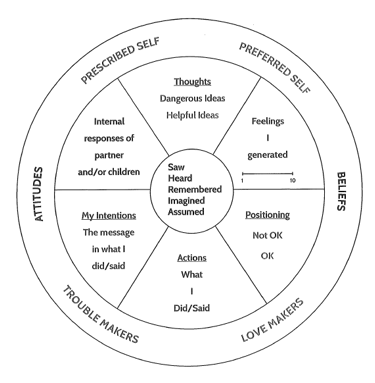
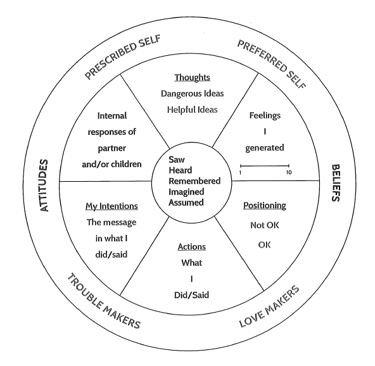
The Helpful Ideas Wheel
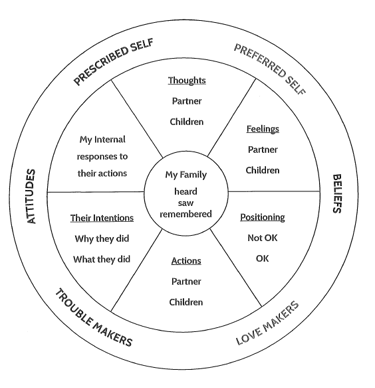
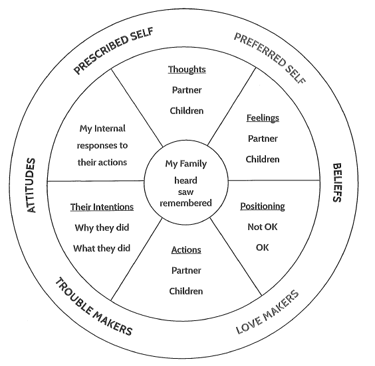
The Empathy Wheel
Descriptions are coming soon
Troublemaker and Healing Wheels
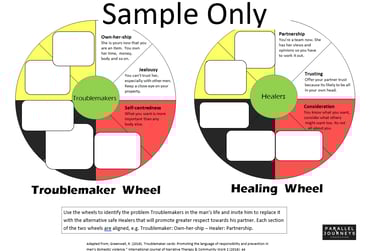
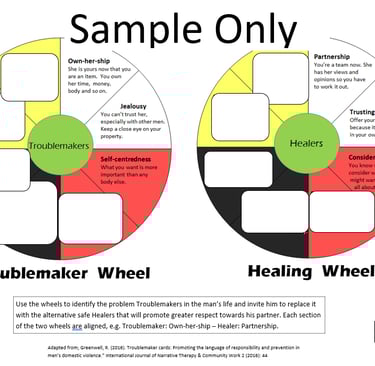
This activity helps men who use violence deconstruct harmful attitudes and ideas (Troublemakers) and explore non-abusive, healing responses (Healers) to situations with their partners. The goal is to identify and replace abusive patterns with respectful and healing actions that align with their hopes for better and safer relationships.
This activity fosters self-awareness, accountability, and practical strategies for behavioural change. By regularly reflecting on and practicing Healers, the man can incrementally improve his relationships and reduce abusive behaviours over time.
Using the wheels, the facilitator chooses a Troublemaker and the alternative Healer from the same section of the wheels, e.g. Own-her-ship and Partnership.
© 2026 Parallel Journeys Consulting
The Gendered Hierarchy of insults: troubling masculinity
Men’s violence does not emerge in isolation. It is shaped within gendered systems that quietly organise power, value, and legitimacy. One of the clearest places to see these systems at work is everyday language. The Gendered Hierarchy of Insults is an experiential group exercise that examines how common insults directed at men and women reveal an unspoken ranking of worth: masculinity at the top, femininity beneath it, and dehumanisation at the bottom. Rather than lecturing about gender theory, the exercise uses men’s own language to expose how dominance, entitlement, and humiliation are embedded in ordinary speech.
As participants map this hierarchy themselves, they begin to see how masculinity is policed through ridicule and reward, and how stepping away from dominance can feel socially risky. This creates space for deeper reflection on responsibility, power, and the relational costs of rigid gender expectations. By unsettling gender norms from the inside, the exercise supports behaviour change that moves beyond compliance and toward ethical accountability grounded in respect, dignity, and care.
The NO Test and Respect Test
Safety planning requires more than agreements on paper. It requires ongoing assessment of how men respond when their authority is challenged or their comfort is disrupted. The No Test and the Respect Test are practical ethical probes designed to examine whether safety is being enacted in real moments. The No Test asks a direct question: when a partner says no, does he accept it as complete, or does he push for a yes through pressure, persistence, emotional withdrawal, or escalation? The answer reveals whether entitlement remains active beneath apparent cooperation.
The Respect Test goes further. It examines how a man responds when fear is expressed. If his partner says she is scared and asks him to leave, does he centre his own interpretation, or does he act to reduce her fear? Passing the Respect Test does not require agreement with her feelings. It requires recognising that fear itself is reason enough to prioritise safety. Together, these tests move the focus from explanation to behaviour, from claimed insight to enacted respect. They strengthen accountability by clarifying that safety is measured not by intention, but by how power is handled when it matters most.
Outsider Witness and Internalised Other
Descriptions are coming soon


Contact Us
Reach out for more information or for a quote.
© 2026 Parallel Journeys Consulting. All rights reserved.
Ryan Greenwell is an Accredited Social Worker and a member of the Australian Association of Social Work.
Parallel Journeys Consulting respectfully acknowledges Aboriginal and Torres Strait Islander peoples as the First Australians, and pay our respects to Elders past and present.
Parallel Journeys Consulting is a registered business name with the Australian Securities and Investment Commission
Australian Business Number: 74 958 982 993